

High-touch customer success gives each account a dedicated CSM, regular meetings and tailored support, and suits complex, high-value customers. Low-touch customer success relies on automation, self-service and digital content to serve many accounts efficiently. Mid-touch sits in between, combining periodic check-ins with digital tools. Most SaaS companies run all three by segment.
The right mix depends on account value, product complexity and available resources. The examples below draw on tips Nisha Baxi of Gong shared in our webinar "Unlocking Success: Inside Stories of Customer Education Implementation." For the automated end of the spectrum, see our explainer on the meaning and principles of low-touch.
What is the difference between high-touch, mid-touch and low-touch customer success?
The three models differ in how much human interaction each customer receives, and therefore in cost, scalability and personalization. High-touch maximizes personalization at a high cost per account, low-touch maximizes scale and consistency, and mid-touch trades some of each to serve accounts that need occasional human attention.
| Aspect | High-touch | Mid-touch | Low-touch |
|---|---|---|---|
| Typical customers | Enterprise, complex or strategic accounts | Mid-market accounts | SMBs and individual users |
| Main touchpoints | Dedicated CSM, frequent meetings, custom onboarding | Periodic check-ins plus digital resources | Automated emails, in-app guidance, knowledge base |
| Cost per account | High | Moderate | Low |
| Scalability | Limited | Moderate | High |
| Personalization | Strong | Targeted | Moderate, segment-based |
| Customer experience | Highly personalized | Balanced | Consistent and reliable |
Many companies now blend models within a single account, for example giving an enterprise executive sponsor high-touch attention while that customer's end users learn through low-touch, in-app resources.
What are the three customer success strategies?
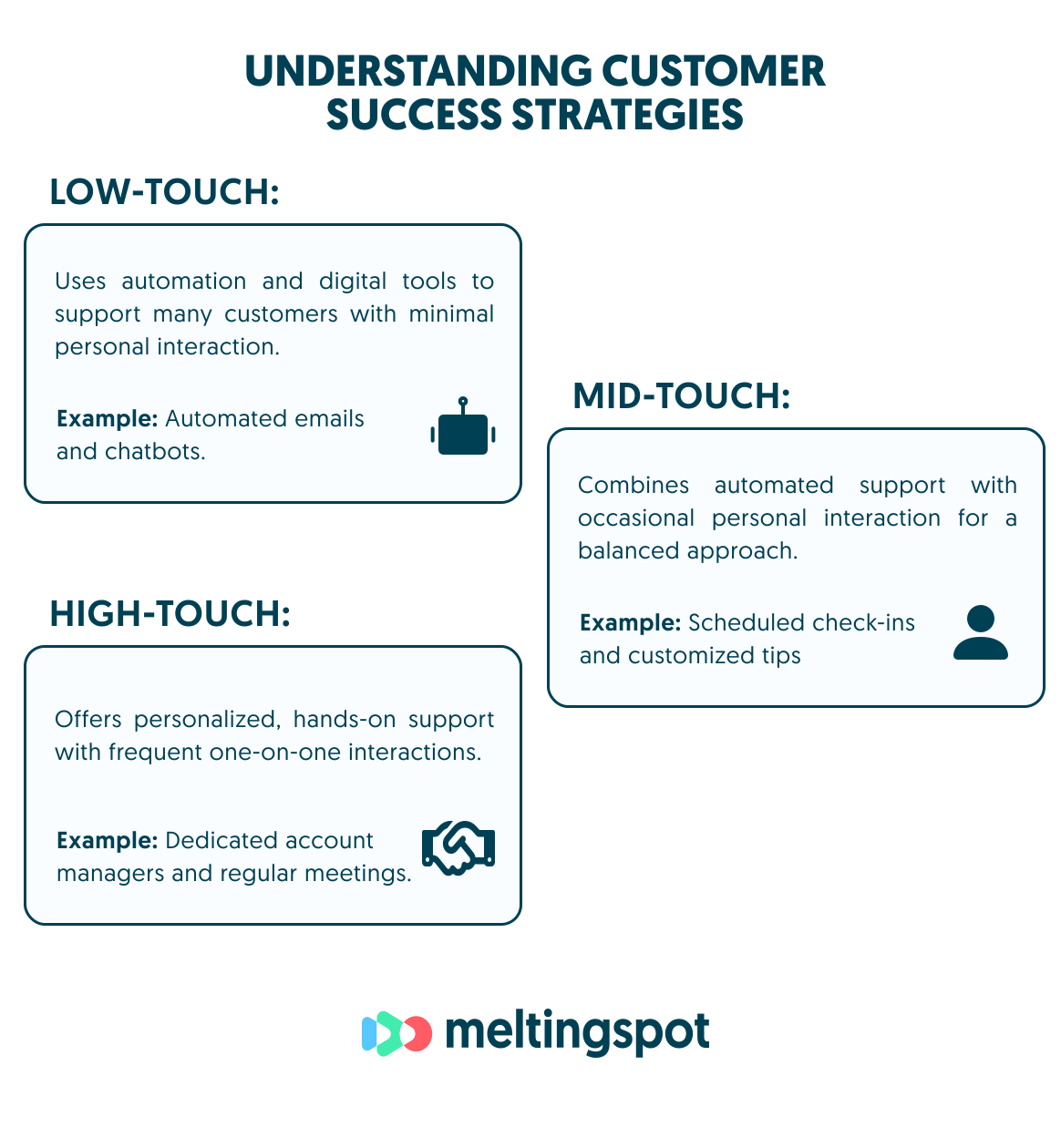
Customer success strategies can be broadly categorized into three types: low-touch, mid-touch, and high-touch. Each strategy differs in the level of interaction and personalization provided to the customer.
1. Low-touch customer success
Low-touch customer success is a strategy that relies on technology and automation to manage customer interactions. Unlike high-touch customer success, which involves personalized and hands-on support, low-touch focuses on using digital tools to handle customer needs more efficiently.
Key elements of low-touch customer success
- Automation: This means using tools like automated emails, chatbots, and self-service portals to assist customers. For instance, an automated email might remind customers of an upcoming renewal, or a chatbot could provide instant answers to common questions.
- Scalability: This approach is designed to manage a large number of customers without needing a proportional increase in resources. For example, a company might use automated onboarding systems to welcome thousands of new users each month, without hiring extra staff.
- Proactive communication: Automated updates and check-ins keep customers informed and engaged, even if they don’t receive personal attention.
Example in practice: Nisha Baxi explains this well: "Digital tools are crucial for handling a wide range of customer needs, especially when many interactions begin in a digital format due to their scale." At Gong, low-touch strategies mean harnessing the power of technology to provide consistent value to all customers, ensuring that even those with minimal needs receive effective and efficient support.
2. Mid-touch customer success
Mid-touch customer success is a strategy that combines occasional personal interaction with automated digital tools. It’s designed for mid-sized accounts or customers who need a balanced level of support: more than a low-touch approach offers, but less than the constant attention of a high-touch strategy.
Key elements of mid-touch customer success
- Segmentation: This involves sorting your customers into groups based on how much support they need. For mid-touch, you identify which segments need a mix of personal and automated support, ensuring that each group gets just the right amount of attention.
- Periodic check-ins: This means setting up regular times to connect with customers through calls or meetings. These check-ins allow customer success managers (CSMs) to stay updated on customer needs and address any issues at planned intervals, rather than being constantly available.
- Customized resources: Personalizing resources and support to fit each customer’s needs. This might include creating custom guides, offering personalized advice, or providing specific training materials based on what each customer requires.
Example in practice: Gong uses a mid-touch strategy for their commercial and mid-market segments. Nisha Baxi explains, "We have four different CSM groups, including our commercial segment, our mid-market segment, and our enterprise segment.” This means Gong has specialized teams for different customer groups. For their mid-market segment, they offer a combination of personal support and digital tools, making sure that mid-sized customers get the right balance of help without needing the intensive, hands-on approach reserved for their largest accounts.
3. High-touch customer success
High-touch customer success is all about providing lots of personalized interaction and support. It’s usually reserved for enterprise customers or those with more complex needs. In this approach, dedicated account managers work closely with each customer, offering a bespoke service experience.
High-touch customer service works like a personal concierge for your top clients: someone who knows their preferences, anticipates their needs and brings solutions before problems escalate. It is less about resolving tickets and more about building deep, trust-based relationships that drive loyalty and long-term success. Our guide to high-touch customer success covers the model in depth.
Key elements of high-touch customer success
- Dedicated customer success managers (CSMs): Each customer gets their own CSM who looks after their account. This means customers always have a go-to person who knows their business well and can offer personalized support.
- Personalized support: This is all about offering custom solutions and proactively solving problems, based on a deep understanding of the customer’s business. It’s like having a tailor-made service that fits the unique needs and goals of each client.
- Regular engagement: This includes frequent, detailed meetings with customers to chat about their progress, challenges, and new opportunities. The idea is to keep in close touch and make sure we’re always on the same page with the customer’s changing needs.
Example in practice: For Gong’s enterprise segment, high-touch strategies are super important. Nisha Baxi shares, "We have our enterprise segment as well, so more of our strategic customers." This means Gong gives their biggest and most complex customers the extra attention they need. By offering tailored support, Gong ensures these clients get exactly what they need to handle their specific challenges and achieve their business goals. This close, personalized approach helps Gong stay aligned with their enterprise customers and provide the right solutions at the right time.
What are the benefits of high-touch and low-touch customer success?
High-touch builds depth, while low-touch builds reach. Each model solves a different problem, which is why the strongest customer success organizations rarely choose one exclusively and instead match the model to the value and complexity of each segment.
Benefits of high-touch customer success
- Stronger relationships: personal attention builds trust and a better understanding of each customer's goals.
- Higher satisfaction: clients who feel understood tend to report better experiences and higher satisfaction scores.
- Proactive problem solving: a CSM who knows the account spots issues before they escalate.
- Higher customer lifetime value: satisfied enterprise customers are more likely to renew, buy additional services and recommend you.
Benefits of low-touch customer success
- Cost efficiency: automating routine interactions lowers the cost to serve and frees budget for strategic work.
- Scalability: automated systems absorb a growing customer base without a matching increase in headcount.
- Consistent service: self-service and automated support are available around the clock, with the same quality every time.
- Better use of CSM time: removing routine tasks lets people focus on complex issues and strategic accounts.
How do you choose the right customer success strategy?
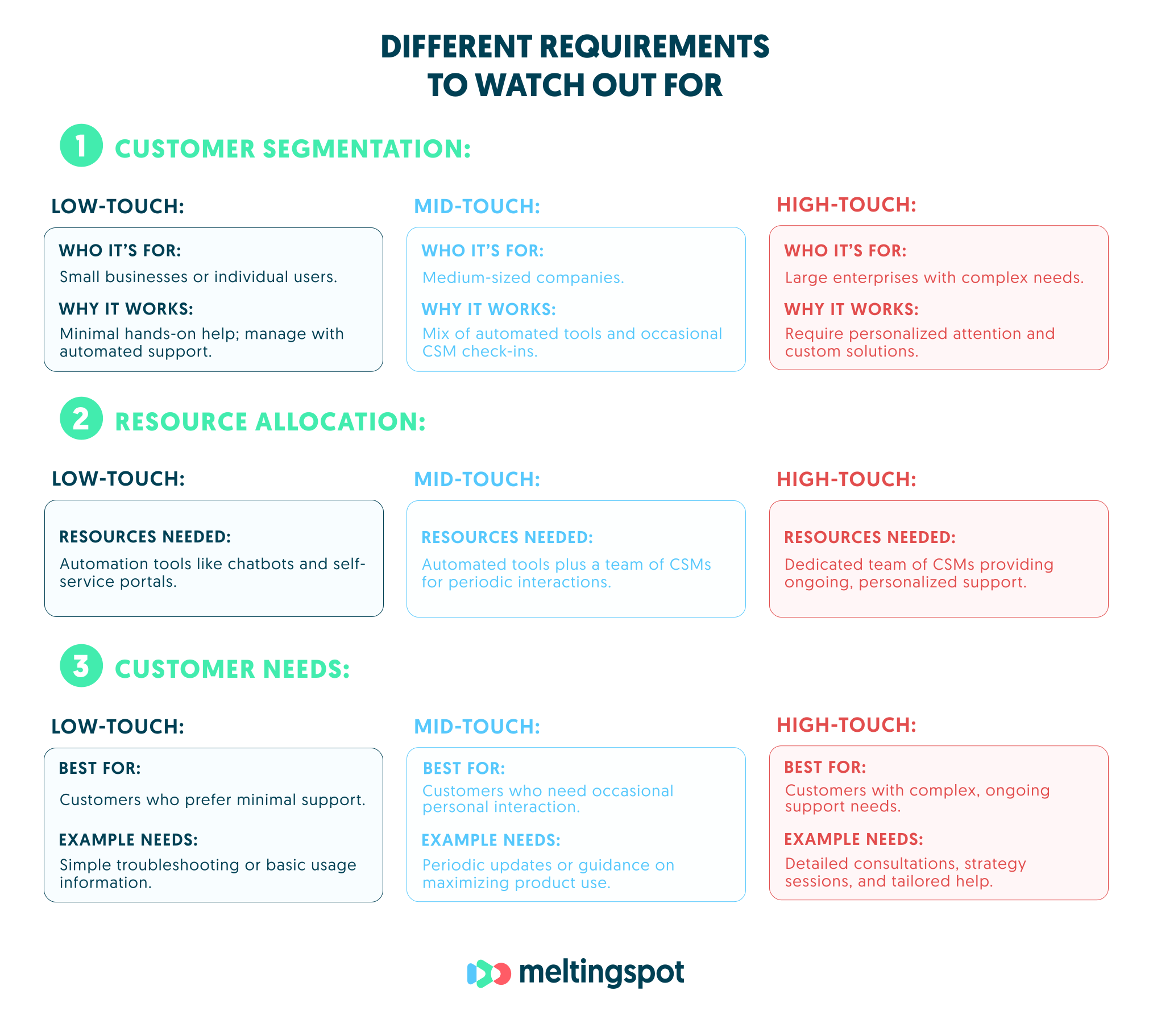
Choosing the right customer success strategy comes down to three factors: the size and value of each customer, how complex their needs are, and the resources at your disposal. Each model, whether low-touch, mid-touch or high-touch, delivers the most value when it matches those factors for a given segment. Our article on adapting customer success to market segments goes further.
NOTE: Before picking the right customer success strategy, make sure you have a clear idea of your customer success platform. Our guide on choosing a customer success platform will give you the insights you need to make the best choice.
1. Low-touch customer success
- Customer segmentation: This strategy is perfect for small businesses and individual users who have straightforward needs.
- Customer needs: Customers in this category usually prefer to find answers on their own through self-service options, without needing much direct interaction.
- Resource allocation: Companies focus on automation tools like chatbots and provide plenty of online resources, such as FAQs and guides, to help customers solve issues independently.
2. Mid-touch customer success
- Customer segmentation: Suitable for mid-sized companies that occasionally need human support along with digital tools.
- Customer needs: These customers appreciate a mix of automated services and personal touchpoints, like occasional check-ins from customer success managers.
- Resource allocation: A balanced approach that uses both automated systems and a team of customer success managers to provide tailored support and resources.
3. High-touch customer success
- Customer segmentation: Best for large enterprises or customers with complex needs that require personalized attention.
- Customer needs: These customers need continuous, in-depth support and benefit from having a dedicated point of contact.
- Resource allocation: Involves assigning dedicated customer success managers who provide customized services, regular meetings, and detailed, hands-on assistance.
How do you implement a high-touch or low-touch strategy?
Implementation starts with the same question for both models: which customer outcomes must the strategy protect? High-touch implementation is about people and cadence, while low-touch implementation is about content, automation and data. Both need analytics to spot problems early.
Steps to implement high-touch customer success
- Assign dedicated account managers who understand each client's industry and act as trusted advisors.
- Schedule regular check-ins focused on the customer's goals and challenges, not just status updates.
- Customize onboarding with personalized training sessions, bespoke tutorials and hands-on support for fast value realization.
- Offer proactive support by monitoring account behavior and reaching out before the client notices a problem.
Steps to implement low-touch customer success
- Automate routine interactions with well-integrated chatbots and automated emails that give accurate answers.
- Build a comprehensive knowledge base of articles, videos and tutorials that customers can easily find.
- Use analytics to monitor behavior and trigger proactive outreach when usage drops.
- Personalize self-service so each segment sees the resources relevant to its use case.
The automated layer is where most programs can still improve. An in-app Learning Agent, such as MeltingSpot's, turns a static knowledge base into conversational, proactive guidance delivered inside the product, so low-touch customers get help at the moment they need it. See our guide to automating customer success for common pitfalls.
How do digital tools support every customer success model?
No matter which customer success strategy you choose, integrating digital tools can significantly enhance both efficiency and effectiveness. Key tools like automation, AI, and data analytics are essential for optimizing any approach, whether it's high-touch, low-touch, or somewhere in between.
Automation and AI
- Streamline routine tasks
Automation helps handle repetitive tasks such as sending follow-up emails or scheduling regular check-ins. An automated system might send a thank-you email to customers after their purchase, or schedule reminders for upcoming renewals. This frees up Customer Success Managers (CSMs) to focus on more strategic activities that require a personal touch.
- Predict and prepare
AI can analyze large volumes of customer data to identify patterns and predict future needs. For example, you might have a tool that uses AI to analyze past customer interactions and then alerts your CSMs about potential issues or opportunities before they arise. This proactive approach allows for timely and personalized support, enhancing overall customer satisfaction.
Data analytics
- Understand customer behavior
By using data analytics, you can uncover how your customers really interact with your product or service. For instance, you might find that those who frequently use certain features are generally more satisfied. This insight will then help you focus on what’s working well and enhance your support and engagement efforts where they’re needed most.
- Refine your strategies
Once you have these insights, use them to fine-tune your approach. If you notice that customers are having trouble with a specific part of your product, you can update your training materials or support resources to better address these challenges. It’s all about continually improving based on real feedback to keep your customers happy and engaged.
How does Gong combine low-, mid- and high-touch customer success?
Earlier, we discussed how Gong effectively uses a blend of low-touch, mid-touch, and high-touch strategies to support their diverse customer base. Gong has organized their support into four distinct CSM groups for different customer segments, along with a specialized team for their enterprise clients.
Learning outcomes
From this case, you should learn that segmenting your customers and applying varied support strategies can provide the right level of assistance to each group. This approach will ensure efficient use of resources and deliver personalized support, leading to greater customer satisfaction and loyalty.
What challenges come with a multi-touch model, and how do you solve them?
Running several models at once creates three recurring challenges: consistency, scalability and resource allocation. Each has a practical fix.
1. Maintaining consistency
It can be tough to keep the customer experience consistent across different support strategies. With various approaches in place, ensuring every customer gets the same level of care can be challenging.
Solution: Standardize key processes and keep all customer interactions in one centralized system. Shared onboarding paths, a single source of educational content and common playbooks ensure that every customer receives a uniform experience, whichever support model they are in.
2. Scalability
As you scale up your high-touch strategies, keeping the quality of service high can become a real challenge. It’s not easy to offer personalized support to a growing number of customers without losing touch.
Solution: Embrace technology to make scaling easier. You can use AI to predict customer needs and automate routine tasks. This will help you manage a larger customer base effectively while still delivering top-notch support.
You can check out our article on how to scale your customer success effectively for some practical tips.
3. Resource management
Figuring out how to distribute resources among low-touch, mid-touch, and high-touch segments can be a bit of a puzzle. It’s important to make sure each segment gets the right amount of attention without stretching your resources too thin.
Solution: Review resource allocation regularly using engagement analytics and segmentation. Track which accounts are growing, which are at risk and which have outgrown their tier, then move them between models. Our guide to customer success KPIs and benchmarks lists the metrics that make those calls objective.
FAQ
What is high-touch customer service?
High-touch customer service is a support model built on frequent, personalized human interaction. Each customer has a dedicated manager who knows their business, holds regular meetings and proactively solves problems. It suits high-value or complex accounts, where the cost of personal attention is justified by retention and expansion revenue.
What is the main difference between high-touch and low-touch customer success?
The difference is the level of human involvement. High-touch relies on dedicated CSMs and tailored support for a small number of accounts. Low-touch relies on automation, self-service content and in-app guidance to serve a large number of accounts. High-touch maximizes personalization, while low-touch maximizes scale and consistency.
Is low-touch the same as tech-touch or digital customer success?
The terms overlap. Tech-touch and digital customer success usually describe the automated, one-to-many layer of a low-touch model. Today that digital layer also supports mid-touch and high-touch accounts, which is why many teams treat digital customer success as a foundation for every segment rather than a separate tier.
When should a customer move from low-touch to high-touch?
Move an account up when its value, growth potential or complexity outgrows self-service, for example after a large expansion, a multi-team rollout or a strategic renewal. Move it down when needs stabilize and digital resources cover them. Review tier assignments regularly using revenue, health and engagement data.
How will AI change high-touch and low-touch customer success?
AI is blurring the line between the two. It enables personalized guidance at scale inside low-touch programs, and predictive analytics helps CSMs anticipate needs in high-touch accounts. As more customer data flows through these tools, strong data security and privacy practices become essential to maintaining trust.
Conclusion
High-touch, mid-touch and low-touch customer success are not competing philosophies but tools for different segments. High-touch builds deep relationships with complex, high-value accounts, low-touch delivers consistent support at scale, and mid-touch bridges the two. As Gong shows, matching the model to each segment is what drives satisfaction and long-term loyalty.