

Product adoption is the process by which a user goes from discovering a product to using it habitually because it delivers real value. Each user follows the adoption process, from awareness to advocacy, while a whole market follows the adoption cycle, from innovators to laggards. Both are tracked with activation, feature usage and retention metrics.
“The faster you can help customers understand and extract value from your product that is in line with their business goals the stickier and more successful they’ll be.” - Jeff Gardner, Director of Customer Success @Intercom
What is product adoption?
Product adoption is the point at which users integrate a product into their routine or workflow and rely on it to reach a goal. A signup, a download or a first login is not adoption. Adoption starts when users repeat the actions that deliver the product's core value without being pushed, and it is confirmed when that usage holds over time.
In B2B SaaS, adoption is tracked at two levels: user adoption (do individuals repeat key actions?) and account adoption (are enough seats, teams and use cases active for the customer to see a return?). For the account-level ratio, see how to calculate product adoption rate.
What are the stages of the product adoption process?
The product adoption process has nine practical stages: awareness, interest, evaluation, trial, activation, adoption, retention, expansion and advocacy. The first five decide whether a user commits; the last four decide whether that commitment lasts and grows. Each stage answers a different question in the user's mind, so one generic onboarding sequence rarely serves them all.
The model descends from Everett Rogers' innovation-decision process, described in Diffusion of Innovations (first published in 1962): knowledge, persuasion, decision, implementation and confirmation. SaaS teams later split implementation into trial and activation and added post-adoption stages, because recurring revenue depends on what happens after the first decision.
Awareness: does the user know the product exists?
Awareness is the stage where a potential user first learns that the product exists and what problem it solves, through search, content, peers or an internal announcement. The goal is a clear value proposition rather than a feature list: users only need to recognize their own problem in your message.
Interest: is the problem worth solving now?
Interest is the stage where the user actively looks for information because the problem feels relevant. Rogers called it persuasion: the person forms an opinion, often shaped by peers and opinion leaders. Educational content works best here: webinars on a common pain point, explainer videos, practical guides.
Evaluation: is this product better than the alternatives?
Evaluation is the stage where the user compares the product with competitors and with the status quo, weighing benefits, compatibility with existing tools, cost and risk. Feature comparisons, case studies from similar companies and direct answers to objections about price or implementation time move users forward.
Trial: does the product work for me?
Trial is the stage where the user tests the product directly, through a free trial, a freemium plan, a demo account or a pilot. A short sign-up, in-app walkthroughs of the essential workflow and fast answers matter more than breadth, because most trial users judge the product on their first few sessions.
Activation: has the user experienced the core value?
Activation is the moment a user first completes the action that delivers the product's core value, often called the aha moment: a first project shared with teammates, a first dashboard built on real data. The faster users get there, the more likely they continue. See how to increase your user activation rate.
Adoption: has the product become part of the workflow?
Adoption is the stage where the user repeats the core actions as a normal routine and relies on the product to do their job. The remaining barriers are habits rather than awareness: the old spreadsheet, the old tool, the old process. Role-based guidance and help delivered at the moment of need support this transition.
Retention: does the user keep coming back?
Retention is the stage where usage persists over months, even after the original champions have moved on. Needs evolve, interfaces change with each release and new hires join the account, so continuous education keeps usage stable. Retention is where adoption shows up in revenue, through renewals and lower churn.
Expansion: does the user explore more of the product?
Expansion is the stage where users adopt advanced features, add use cases or bring in more seats and teams. The main obstacle is visibility: many users never discover capabilities that would solve problems they already have. Contextual education aimed at users who have mastered the basics turns existing usage into deeper value.
Advocacy: does the user recommend the product?
Advocacy is the final stage, where satisfied users recommend the product to peers, write reviews or champion it internally. It cannot be forced, but referral programs, customer communities and testimonials encourage it. Advocates feed the early stages for other users, closing the loop.
Why do users stall in the product adoption process?
Users stall in the adoption process mainly because of resistance to change, complex onboarding, low perceived value, missing support and guidance that ignores their role. Most are learning problems, not product defects, so they can be fixed without rebuilding features. Our product adoption strategies guide details the full playbook.
Resistance to change. People are attached to familiar workflows, even inefficient ones. A team used to manual reports may resist a cloud analytics tool simply because the old way feels safe. Showing compatibility with existing tools, quantifying time saved and recruiting internal champions reduce this friction.
Complex onboarding and low perceived value. When setup demands many integrations and settings at once, users abandon before the aha moment. When messaging is generic, users who only need one use case do not see why the product matters to them. Leading with one quick win tied to the user's job fixes both problems at once.
Limited support and role misalignment. Users who hit a wall on an advanced feature with no help nearby disengage, and an administrator, a manager and an occasional contributor do not need the same guidance. Proactive tips, a self-service knowledge base and role-based paths keep each persona on the features that matter to them.
What is the product adoption cycle?
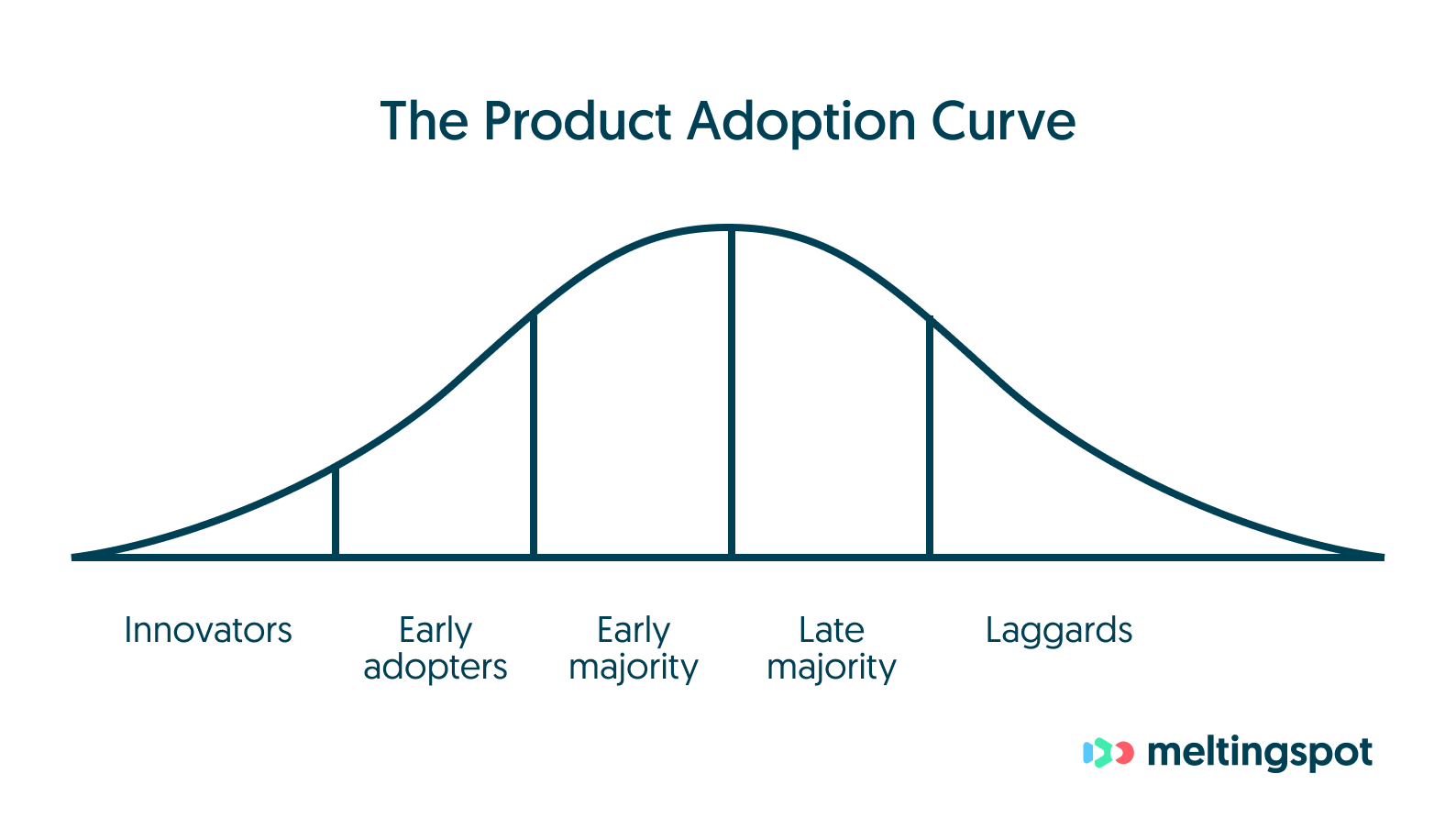
The product adoption cycle, also called the product adoption curve or technology adoption curve, describes how a new product spreads across a market over time, from the few who try it first to the last who accept it. It segments buyers into five groups, from innovators to laggards, and is usually drawn as a bell curve.
Who are the five adopter groups?
The five adopter groups come from Everett Rogers' Diffusion of Innovations, which gave each a share of the population based on a normal distribution. These are theoretical proportions, not measurements of a specific market, but they help you reason about who you are selling to.
- Innovators (2.5%): risk-takers and technology enthusiasts who tolerate bugs and give early feedback.
- Early adopters (13.5%): opinion leaders seeking a strategic advantage, whose endorsement reassures others.
- Early majority (34%): pragmatic buyers who want proven results and peer references first.
- Late majority (34%): skeptics who adopt once the product has become a standard.
- Laggards (16%): resistant to change, often adopting only when the old option disappears.
How should you adapt your approach to each adopter group?
Each adopter group needs a different argument: novelty for innovators, strategic advantage for early adopters, peer proof for the early majority, simplicity for the late majority and necessity for laggards. Geoffrey Moore's Crossing the Chasm (1991) adds that the gap between early adopters and the early majority is the hardest to cross. Our guide to the technology adoption lifecycle covers the chasm in detail.
Does the adoption curve also apply inside a single customer account?
Yes, the adoption curve repeats inside every B2B account that rolls out a new tool. A few enthusiastic users adopt immediately, a pragmatic majority waits for colleagues to validate the tool, and reluctant users keep the old process until it is switched off. Turning internal innovators into champions is the fastest way to reach the majority.
What is the difference between the product adoption process and the product adoption cycle?
The product adoption process describes the stages one user goes through, while the product adoption cycle describes how adoption spreads across a whole market. The process repeats for every new user; the cycle unfolds once per product or category. Confusing them leads teams to fix a market problem with onboarding, or the reverse.
| Dimension | Product adoption process | Product adoption cycle |
|---|---|---|
| Unit of analysis | One user or one account | A market or population |
| Question it answers | Where is this user stuck? | Who will buy next, and what convinces them? |
| Stages | Awareness to advocacy | Innovators to laggards |
| Time scale | Days to months per user | Years per product or category |
| Main owners | Product, onboarding, customer success, L&D | Marketing, product marketing, leadership |
| Key metrics | Activation rate, time to value, feature adoption, retention | Market penetration, customer mix and win rate by segment |
| Main levers | Onboarding, in-app guidance, continuous education | Positioning, references, pricing, distribution |
How do you measure product adoption?
You measure product adoption by tracking how many users reach the core value, how fast, how deeply and for how long. A balanced scorecard combines activation rate, time to value, feature adoption, stickiness, retention and revenue retention, completed by satisfaction signals such as NPS. Each reflects a different stage; our guide to user adoption metrics details the formulas.
Which product adoption metrics matter most?
- Product adoption rate: the share of users actively using the core features over a period.
- Activation rate: the share of new users who complete the activation event.
- Time to value: the time between signup and the first meaningful outcome.
- Feature adoption rate: users of a feature divided by total active users.
- Stickiness: daily active users divided by monthly active users, a proxy for habit.
- Retention and churn: the share of users or accounts still active, or lost, after a period.
- Net revenue retention (NRR): revenue kept and expanded from existing customers, net of churn.
- NPS and CSAT: willingness to recommend and satisfaction.
Which metric shows that a user has reached each stage?
Each stage of the adoption process has its own observable signal, and mapping one metric per stage shows exactly where users drop off. Adapt the activation and adoption events to your own core value; the same logic applies to single features, as the feature adoption funnel shows.
| Stage | Metric that confirms it |
|---|---|
| Awareness | Branded search volume, qualified traffic |
| Interest | Content-to-lead conversion |
| Evaluation | Trial or demo request rate |
| Trial | Setup completion rate |
| Activation | Activation rate, time to value |
| Adoption | Product adoption rate, DAU/MAU |
| Retention | Retention cohorts, churn rate |
| Expansion | Feature adoption rate, NRR |
| Advocacy | NPS, referral rate |
How do you turn adoption data into action?
Adoption data becomes useful when it points to a stage and a segment. A drop between setup and activation calls for simpler onboarding; low feature adoption among retained users calls for contextual education; falling usage in one role calls for role-specific guidance. Change one lever at a time, then measure again.
Why is product adoption important?
Product adoption is important because it is the leading indicator of retention, expansion and referrals: users who do not adopt do not renew, do not upgrade and do not recommend. In subscription businesses, the value of every sale depends on adoption after it.
How does adoption reduce churn?
Adoption reduces churn because customers renew what they actually use. Users who fail to see value in their first weeks quietly disengage long before the renewal date, often unnoticed until it is too late. Tracking activation and early usage turns churn from a surprise into a pattern that can be addressed account by account.
How does adoption drive expansion revenue?
Adoption drives expansion revenue because upsells and extra seats follow proven value. A team that relies on a product daily asks for more licenses; a team that barely logs in negotiates seats down. Unused features weaken the perceived value of every renewal, which is why net revenue retention is ultimately an adoption metric.
How does adoption create advocates and a competitive edge?
Only users who get value recommend a product, and according to Nielsen, 92% of consumers trust recommendations from people they know. A well-adopted product is also hard to replace: once embedded in workflows and familiar to every team member, switching costs rise. Competitors can copy features, not the habits strong adoption creates.
How does a Learning Agent accelerate product adoption?
A Learning Agent accelerates product adoption by delivering guidance inside the product at the moment a user is stuck, instead of sending them to documentation. It targets the stages where users stall most often, activation, adoption and expansion, where the barrier is knowing how rather than wanting to.
Unlike a static product tour or a reactive support chatbot, a Learning Agent is proactive and conversational: it detects friction in the workflow, answers in context and reuses existing tutorials, videos and help articles. MeltingSpot's Learning Agent is deployed through a Chrome extension without product development, and can act as a digital customer success manager for low-touch accounts.
FAQ
What are the 5 stages of product adoption?
The classic five stages are awareness, interest, evaluation, trial and adoption, mirroring Everett Rogers' innovation-decision process. SaaS teams usually add activation between trial and adoption, then retention, expansion and advocacy afterward, because recurring revenue depends on usage long after the first decision.
Is the product adoption cycle the same as the product life cycle?
No. The product life cycle tracks a product's sales through introduction, growth, maturity and decline. The adoption cycle describes which groups of buyers adopt it, from innovators to laggards. Growth usually coincides with reaching the early majority, but the two answer different questions.
What is a good product adoption rate?
There is no universal benchmark, because adoption rate depends on how you define an active user, the product category and the period measured. The most useful comparison is with your own cohorts: a rising share of new users reaching the core action in their first weeks shows onboarding is working.
How long does product adoption take?
Adoption time ranges from minutes for a simple app to several months for complex B2B software such as an ERP or a CRM. The more useful target is time to value, how quickly a user completes a first meaningful action, because shortening it has the strongest effect on whether users continue.
What should you remember about product adoption?
Product adoption is the move from discovery to habitual, value-driven use. Each user follows the adoption process from awareness to advocacy, while the market follows the adoption cycle from innovators to laggards. Measure both with stage-specific metrics such as activation rate, time to value, feature adoption and retention, and treat adoption as the leading indicator of revenue.